When you're taking on commercial-grade cargo, the decision between upgrading to an F-250 vs. F-350 model is important. The F-250 offers better fuel economy and a more comfortable driving experience while towing up to 23,000 pounds with a gooseneck hitch.1 However, the 2026 F-350 can reach 38,000 pounds of tow rating.1
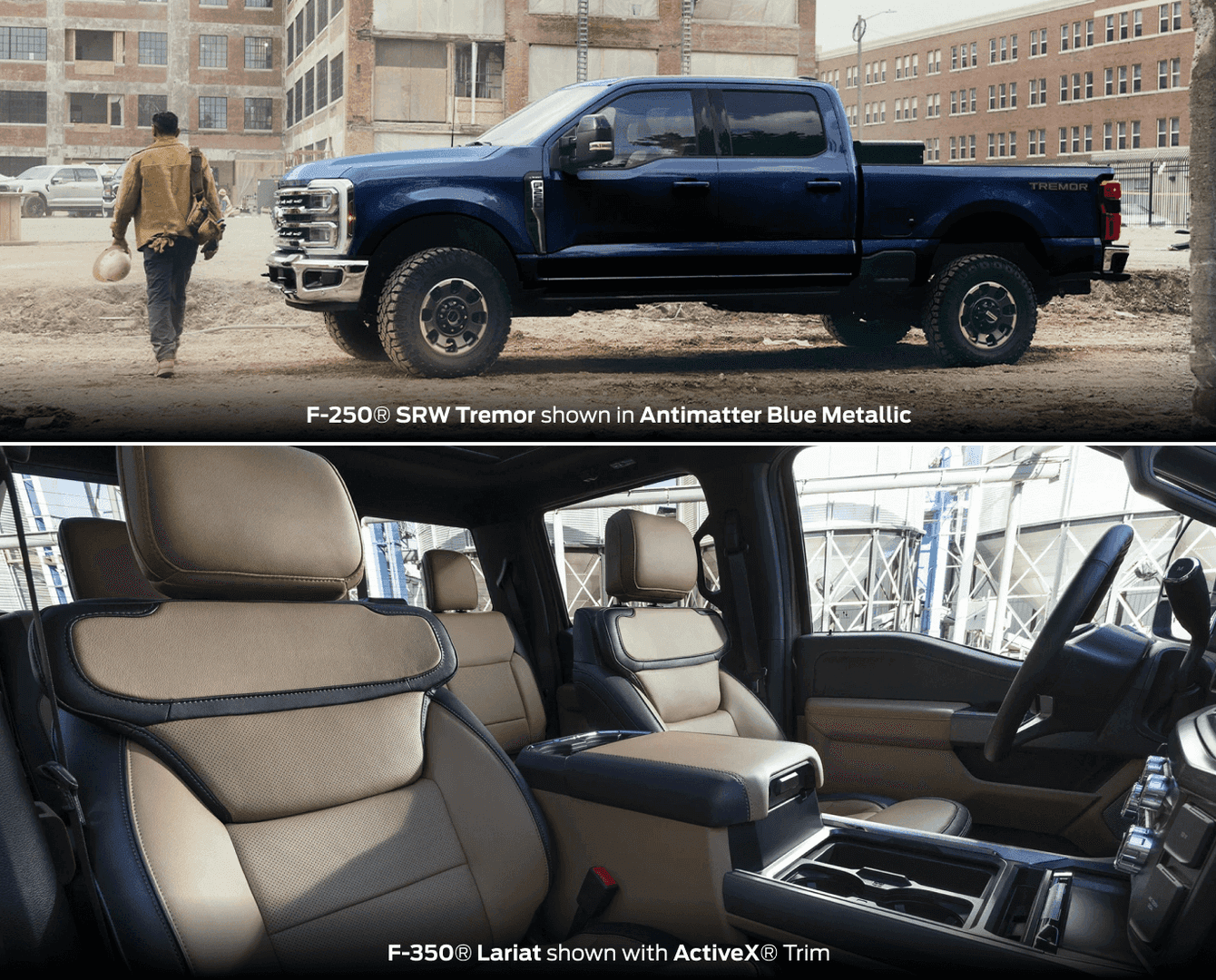
The F-250 and F-350 are quite similar on the exterior, with the same paint options and varied accents. Even a comparison of the F-250 vs. F-350 trim levels shows that each truck has five options that share the same names. The sole difference is wheel size and design, with the bulkier Ford Super Duty for sale having slightly larger wheels.
Similarly, a look between the F-250 vs. F-350 interior reveals two nearly identical cabins. From standard vinyl upholstery to available leather seating, these models provide a comfortable and welcoming experience.

As you explore our new Ford inventory, you'll notice that there are four F-250 vs. F-350 engine options:
The standard 6.8-liter V-8 makes 405 horsepower, which is good for most work while also providing the highest payload rating for the F-350. The 6.7-liter Turbo Diesel can make up to 1,200 pound-feet of torque with its high-output variant and also provides the best towing metrics for each truck.
The F-250 vs. F-350 fuel efficiency battle isn't carved in stone, since the EPA doesn't rate heavy-duty trucks for MPG ratings; however, we expect that the F-250 makes better use of the 48-gallon tank, thanks to its smaller size.
Now we get to the most significant difference between F-250 and F-350 trucks: F-250 vs. F-350 towing capacity. The F-250 is an incredible towing companion, capable of hauling 22,000 pounds conventionally or 23,000 pounds with gooseneck towing.1 The F-350 is made for much larger cargo volumes, with a conventional towing capacity of 28,000 pounds and a gooseneck capacity of 38,000 pounds.1
The F-250 vs. F-350 payload comparison is a closer match. The F-250 caps out at 4,246 pounds, which is enough for many DIY tasks or most worksites.2 The F-350 reaches 5,137 pounds with a single rear wheel;2 however, if you choose the dual rear-wheel setup, you can carry up to 8,000 pounds in the bed and cabin.2


The final part of our Ford Super Duty comparison comes down to the F-250 vs. F-350 technology and comfort within their respective cabins. The 2026 F-250 Lariat, for example, comes with a 12-inch LCD productivity screen, as does the F-350 Lariat. This trim also features a wireless charging pad, heated steering wheel, and SYNC 4 technology.
F-250 vs. F-350 safety features are much the same, with comprehensive sensor technology like Rear View Cameras that give you a better view. If you want to invest in additional features, you can access options such as Intersection Assist and 360-Degree Cameras.
Get a full tour of either model here at Pettijohn Ford of Trenton and experience both behind the wheel with back-to-back test drives. Our team can also introduce you to our supply of Ford vehicle specials that may apply to your new ride.
The primary difference between the Ford F-350 vs. F-250 is in the tow rating and weight of the chassis. The F-250 is a lighter model, able to tow up to 23,000 pounds when properly equipped, and thus is more fuel-efficient and maneuverable. The F-350 is the bulkier model, which allows it to tow up to 38,000 pounds with a gooseneck hitch.1
The F-350 is worth it if you get the dual-rear wheel configuration and need to tow over 30,000 pounds.1 The F-250 is more fuel-efficient and can still tow 22,000 pounds conventionally,1 which is more than enough for nearly any domestic or commercial job. The extra capability of the F-350 is almost exclusively for heavy-duty commercial projects.
It is absolutely possible to drive an F-350 daily, though the F-250 will offer better fuel efficiency and a more comfortable driving style. The F-350 is significantly heavier than the F-250, so despite them sharing a maximum tank size of 48 gallons, you'll notice an easier driving experience with the smaller sibling. However, only the F-350 can tow nearly 40,000 pounds when properly equipped.
| Ford F-250 | Ford F-350 | |
|---|---|---|
| Engine Options |
|
|
| Conventional Towing Capacity | 22,000 lbs1 | 28,000 lbs1 |
| Fifth-Wheel Towing Capacity | 22,300 lbs1 | 35,000 lbs1 |
| Gooseneck Towing Capacity | 23,000 lbs1 | 38,000 lbs1 |
| Payload Capacity | 4,246 lbs2 | 8,000 lbs2 |
| Trim Levels |
|
|
| Drivetrain | 4x2, 4x4 available | 4x2, 4x4 available |
| Available DRW? | No | Yes |
| Max GAWR (Front / Rear) | 5,600 / 6,340 lbs | 5,600 / 10,300 lbs |
1When properly equipped. See dealer for details.
2Maximum payload capabilities are for properly equipped vehicles with required equipment and vary based on vehicle configuration, accessories, and option content. Horsepower, torque, payload and towing are independent attributes and may not be achieved simultaneously.